Will my child's food allergy get better as they grow up? It depends on the allergen and on proper assessment
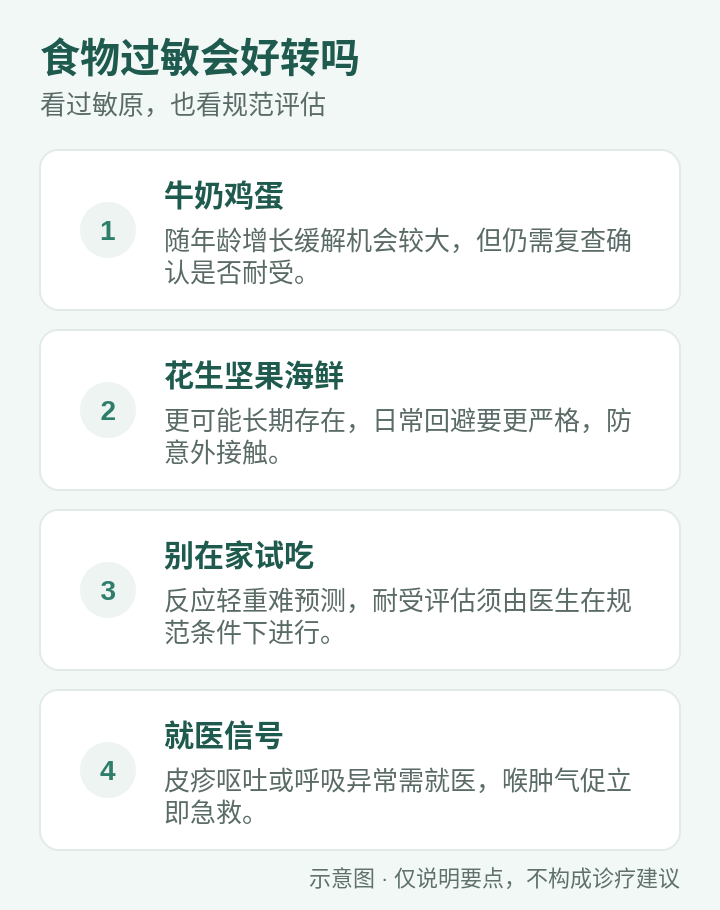
Cow's milk and egg allergy often ease with age, while peanut, tree nut and shellfish allergy are more likely to persist. Whether a child has outgrown an allergy cannot be judged by trying foods at home; it needs proper assessment by a doctor.
Review status: automated publication checks completed. No named medical-professional review is declared. Editorial and review policy
Not all food allergies are the same: why some get better and some stay as your child grows
Food allergy is when the immune system treats a certain food as a threat and overreacts. A child's immune system and gut barrier are still developing, and the way they come into contact with foods is changing too, so the allergy may change as well.
The "natural course" differs a lot between allergens. Children with cow's milk allergy or egg allergy have a higher chance of outgrowing them as they get older; peanut allergy, tree nut allergy and allergy to fish, shrimp and shellfish are more likely to continue into school age or even adulthood. This is not absolute, and individual differences are large.
So parents first need to find out which type of allergen their child has, and then talk about "whether it will get better". Asking generally "can food allergy get better?" often gives an answer that does not match your own child's situation.
Cow's milk and egg: a greater chance of outgrowing, but still confirm with follow-up
Cow's milk and egg are the most common food allergens in infants and young children, and they are also the two types that most often ease with age. Some children gradually become tolerant after a few years, but the timing and proportion of outgrowing vary from person to person.
The key word is "confirm". Your child no longer getting a rash or vomiting does not mean they are already tolerant. Some children have simply not come into contact with the food recently, or their symptoms have become milder.
Whether your child is already tolerant needs a doctor to assess, taking into account past reactions and allergen test results, and if necessary assessing under proper conditions. Parents should not relax avoidance management just because they "heard it gets better as they grow up", and should not open up the diet on their own just because "it might be better".
Peanut, tree nut and shellfish: more likely to persist, do not take chances
Peanut allergy, tree nut allergy and allergy to fish, shrimp and shellfish are relatively more likely to last a long time. Once a clear reaction has happened with this type of allergy, everyday avoidance needs to be stricter, especially to prevent accidental contact.
Families and schools of these children need to prepare in advance: read food labels carefully, communicate with teachers about lunch and snack arrangements, and make clear how to respond if a reaction occurs.
Do not give a little to try just because "the child is still young and might outgrow it". For a food allergy that may persist, one chance-taking try can lead to a severe reaction.
Why you cannot try foods at home yourself
Parents often think: "Just give him a small bite and see if he is still allergic." This approach carries considerable risk. The severity of an allergic reaction is hard to predict; last time it was only redness around the mouth, but the next time may not be as mild.
The proper way is for a doctor to assess and then do it in a place with emergency facilities. At home there is no such preparation, and if airway symptoms appear, handling will be very difficult.
For everyday management, keep avoiding what should be avoided, and go for follow-up checks as arranged by the doctor. Do not try foods your child was previously allergic to at home yourself; this is a bottom line.
Which signs mean it is time to see a doctor
The following situations need medical assessment: your child has had a rash, vomiting, diarrhoea or redness around the mouth after eating a certain food; symptoms appear shortly after eating; there is a family history of allergy.
Go to the emergency department immediately if these occur: sudden swelling of the lips, tongue or throat; rapid breathing, wheezing or a hoarse voice; difficulty swallowing; the skin or lips turning blue, grey or pale; the child suddenly very sleepy, slow to respond or floppy. If there is any abnormality in breathing or consciousness, call 120 (the emergency number in China) immediately.
If your child has already used emergency medicine, go to the hospital even if they seem to be getting better. Leave the later confirmation of the allergen and the tolerance assessment to the doctor; parents are responsible for keeping records and cooperating.
This article is for general information only and is not medical advice. Please follow your doctor's instructions for your specific situation.
Reference links
This article is for general information only and is not medical advice. If your symptoms affect daily life, please see a doctor.