Why people with peanut allergy are advised to watch out for other legumes
Explains what cross-reactivity between peanut and other legumes means, which foods may be involved, how to observe and keep records at home, and when to see a doctor for assessment.
Review status: automated publication checks completed. No named medical-professional review is declared. Editorial and review policy
Why peanut allergy comes with a warning to watch other legumes
Although the name contains "nut", peanut actually belongs to the legume family. The legume family is large and includes soy, peas, lentils and chickpeas. The proteins in different legumes have similarities, and the immune system sometimes mistakes one for another. This is what is usually called cross-reactivity.
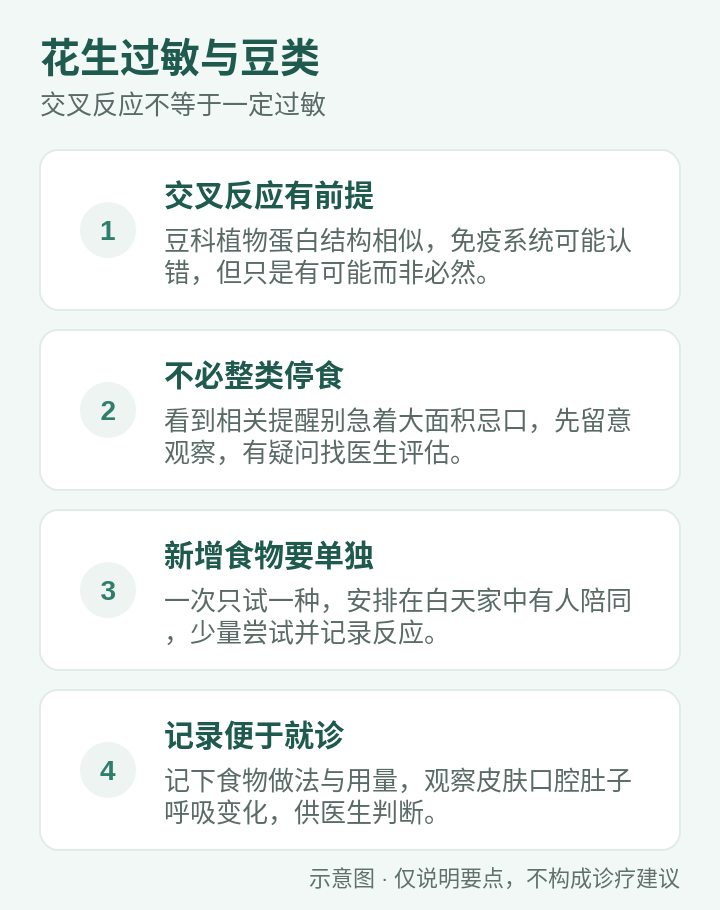
But one thing should be made clear first: cross-reactivity means "possible", not "certain". A related result on a test, or similar protein structure, does not mean eating the food will definitely cause an allergy. Whether symptoms actually appear depends on each person's own response, and a doctor needs to judge this together with the medical history.
So when you see statements like "peanut allergy means being careful with other legumes", you do not need to stop the whole food group straight away. A safer approach is to treat it as a reminder: pay attention, observe, and see a doctor for assessment when in doubt, rather than cutting out a large range of foods on your own first.
Which foods are often mentioned, and how to watch day to day
From the mechanism, the foods mentioned most are other legume foods, such as soy, peas, lentils and chickpeas. In addition, some people with pollen allergy get an itchy mouth when eating certain raw fruits or nuts. This is another type of cross-reactivity, not the same as legumes, but it also shows that "related" does not mean "certain".
Day-to-day observation can start with these points:
Add only one new food at a time; do not try several at once.
Record what was eaten, how much, and how long after a reaction appeared.
Watch for signs such as an itchy mouth, rash, abdominal pain and vomiting.
Keep avoiding foods already known to cause allergy; do not "test them back" on your own.
For a new food, try a small amount the first time, during the day, at home, with someone present. This way, if there is a reaction, it can be handled promptly and is easier to record.
If a child is already known to have peanut allergy and the family wants to try foods such as peas or lentils, it is safer to talk to the doctor first. The doctor will look at past reactions, test results and the child's overall situation, then decide whether to try and how to try.
Keep a simple food observation record
It does not need to be complicated; a sheet of paper or a phone note is enough. Each time you try a new food, write down the date, the food name, how it was prepared (raw, cooked, whole or as a paste), and roughly how much was eaten.
Then keep two more columns: whether there was anything unusual within two hours after eating, and whether there were changes later that day. Look at the skin, mouth, stomach and breathing. If there are symptoms, write clearly what they were, how long they lasted and how they eased.
Keep observing and recording for at least two hours; if there is lip swelling or breathing discomfort, seek medical care immediately. This record is very useful at a doctor visit, because the doctor can use it to judge which reactions are true allergy and which are only coincidence.
When to see a doctor
If the following signs appear, do not keep observing at home; seek medical care as soon as possible or see an allergy specialist for assessment:
After eating a certain legume, swelling of the lips, tongue or throat, or a hoarse voice.
Wheezing, chest tightness, difficulty breathing, or repeated coughing.
Large areas of urticaria (hives) over the body, with dizziness, pale face or low energy.
Repeated vomiting or obvious abdominal pain, with a clear link to the time of eating.
When two or more body systems are involved, treat it as anaphylaxis and call for emergency help. The systems here mean the skin, breathing, digestive tract and circulation being affected at the same time or one after another.
If it is only a slightly itchy mouth after eating a certain legume each time, or a few scattered spots of rash, it is still worth mentioning at the next follow-up visit. The doctor will judge whether further tests are needed; do not draw conclusions yourself, and do not cut out a large range of foods on your own.
Do not keep widening the list of foods to avoid
Information about cross-reactivity can easily make people anxious, and when anxious they stop all legumes. The wider the range of foods avoided, the harder it is to ensure good nutrition, for children and adults alike. What really needs to be avoided is food that has already clearly caused a reaction.
For foods that are only "flagged as related on a test", it is usually not necessary to avoid them all in advance. Whether to try them, where to try them and in what form is better left to the doctor's assessment. What the family can do is keep solid observation records and bring the suspicious clues to the doctor.
This article is for general information only and is not medical advice. Please follow your doctor's instructions.
Reference links
This article is for general information only and is not medical advice. If your symptoms affect daily life, please see a doctor.